03 // Demo + Milestones

Watch the system become useful.

A protected early-build demonstration followed by the practical milestones now emerging from limited learning.

Early Build Demonstration

A 2015 laptop. Well under 77 MB. The first glimpse of a different scaling law.

HISTORICAL DEVELOPMENT CAPTURE NOTICE
Some early-build captures on this page retain pre-SIDE interface naming exactly as recorded. They are preserved as historical development evidence rather than digitally rewritten to resemble a later release.

This recording captures one of the earliest XERXES builds operating with deliberately limited learning and only the initial seeding of language comprehension. It is not a showcase of a mature knowledge base. It is a demonstration of what the architecture is already beginning to do before broad learning has even been loaded.

The result is difficult to dismiss as a simple size comparison. XERXES is beginning to reach milestones normally associated with LLM-style systems—contextual conversation, structured comprehension, multi-step organization, memory-aware interaction, and increasingly coherent reasoning behavior—while the complete working environment remains well under 77 MB for the demonstrated package—including the engine, XERXES BRAIN DESIGN STUDIO/web UI, Messenger, documentation, part of the development environment, and the small initial learning/comprehension seed.

XERXES // DEVELOPMENT CAPTURE // 73 SECEARLY SYSTEM EVIDENCE
Preview of the XERXES early-build demonstrationHISTORICAL DEVELOPMENT CAPTURE // AUG 2026 // PRE-SIDE INTERFACE NAMING PRESERVED AS CAPTURED
WHAT YOU ARE WATCHING: an early, limited-learning XERXES cognitive build—not a frontier LLM and not a mature final system—already producing behavior significant enough to justify direct comparison against milestones commonly associated with language-model systems.
WHY THE LEARNING ASYMMETRY MATTERS: this capture came from a build with only a very small amount of seeded learning data. Yet the system was already assembling useful behavior across conversation, comprehension, routing, reasoning organization and code-oriented tasks. The evidence does not establish general superiority over frontier LLMs; it does establish a remarkable capability-to-seeded-data ratio worth rigorous comparative testing.
Complete footprint< 77 MBEngine + Studio/web UI + Messenger + documentation + part of the development environment + sparse initial learning/comprehension data.
Test machine201515-inch MacBook Pro running the demonstration with other applications active.
Host resources2.8 GHz16 GB RAM; no dedicated modern AI accelerator required for this capture.
Installed GPUR9 M370XAMD Radeon GPU present, but not used by the demonstrated cognitive workload.

The machine includes an AMD Radeon R9 M370X, yet the cognitive path shown here is running without GPU acceleration. Current observations suggest that XERXES' short, sparse computational shortcuts can be fast enough that moving these small operations to the GPU may add more transfer and dispatch overhead than it removes. More complex workloads may cross that threshold and benefit from GPU execution. That tradeoff still requires controlled profiling.

This matters because the experiment points at a possibility much larger than a small demo: some capabilities we have learned to associate primarily with enormous parameter counts may also depend on how cognition is organized, routed, corrected, remembered, and selectively expanded.

Research status: these are early-build observations, not a claim of frontier-LLM parity. The breadth, learned world knowledge, and unconstrained generality of frontier models are not claimed here. Hardware utilization and CPU/GPU crossover behavior remain active test questions.

If the signal survives larger learning sets and harder controlled tests, the implication is enormous: we may not simply have built a smaller AI. We may be discovering a different way to build cognition.

Inspectable Intelligence // Working-System Evidence

The system does not only produce an answer. It can expose what participated in producing it.

These captures mark a deeper transition in XERXES: capability is becoming visible at multiple levels at once—user-facing skills, event-by-event diagnostics, and individual neural participation. The result is an AI research environment in which the interface can move from what happened toward which computational structures were involved, what they were doing, and when they did it.

This is public evidence of outcomes and observability only. The proprietary formulas, weights, routing policies, learning mechanisms, and internal decision rules that produce these states remain undisclosed.

04MODEL INSPECTOR
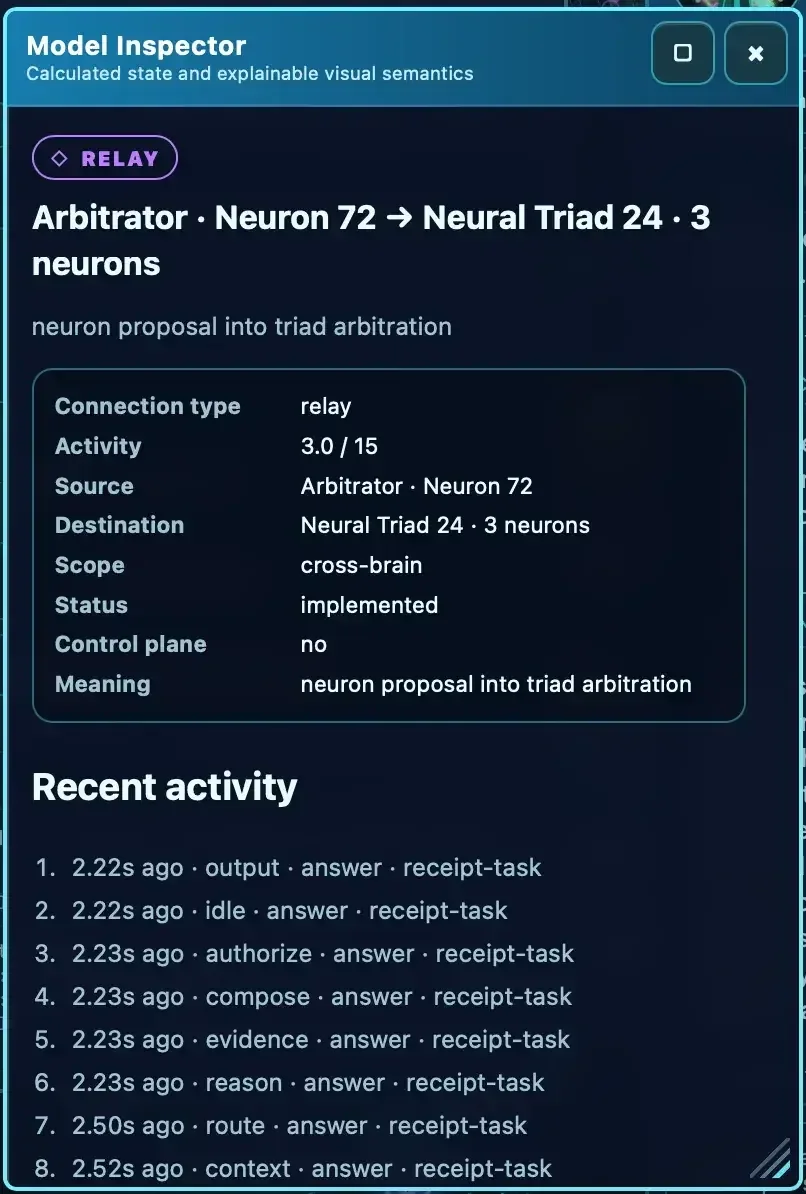
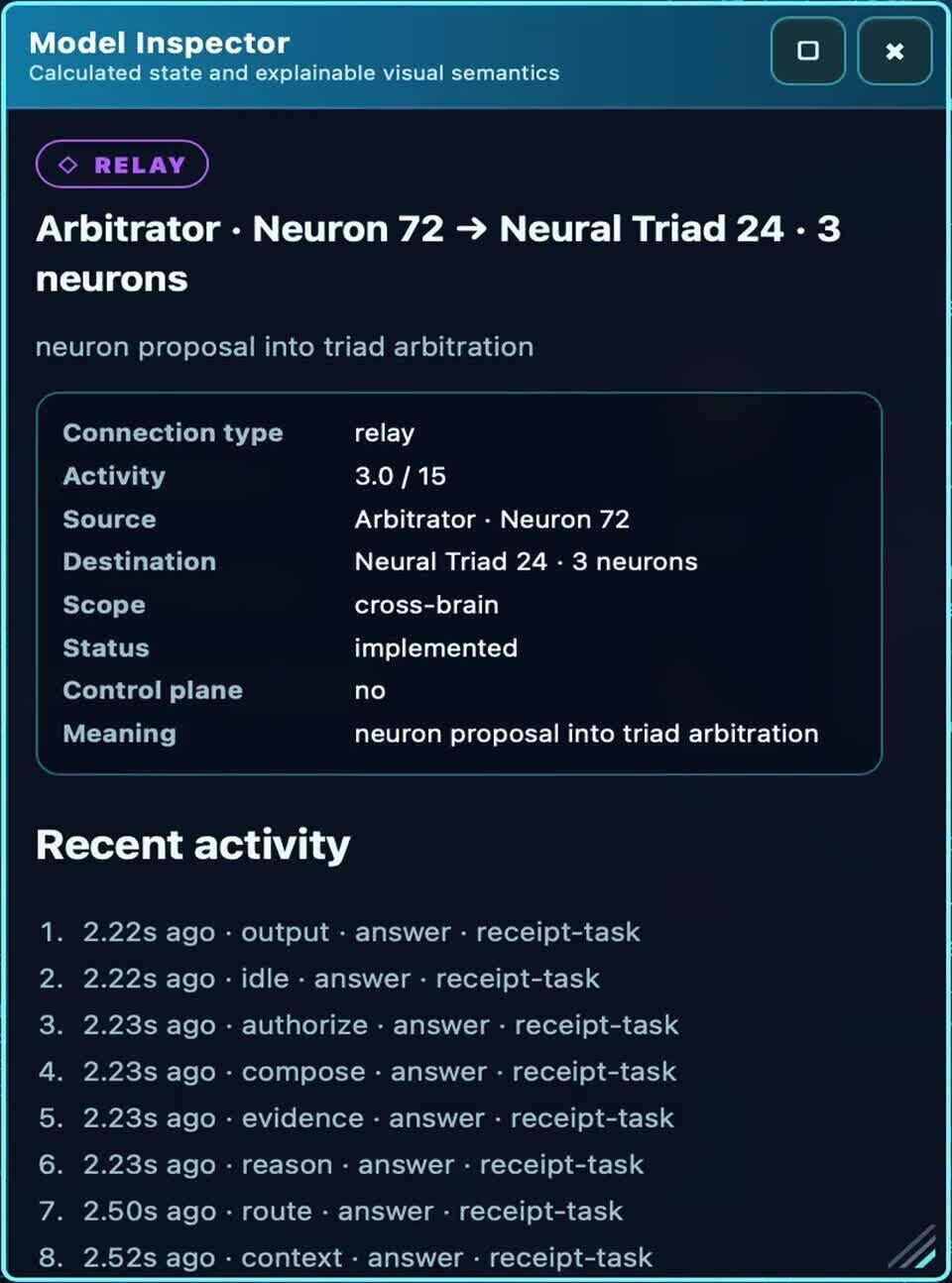
XERXES Model Inspector displaying a relay connection from Arbitrator Neuron 72 to Neural Triad 24 with activity, source, destination, scope, status, meaning, and recent event activity.DEVELOPMENT EVIDENCE // AUG 2026 // SOURCE UI PRESERVED
XERXES // PUBLIC EVIDENCE // PROPRIETARY

A neuron is no longer an anonymous dot.

The inspector identifies an Arbitrator · Neuron 72 relaying a proposal into Neural Triad 24. It exposes the connection type, source, destination, cross-brain scope, implementation status, semantic meaning, activity level, and a recent event trace.

Why it matters: the architecture is becoming inspectable at the level of participating computational units. Investors are not being asked to accept a decorative brain animation; the system can surface operational state attached to a specific neuron-to-group relationship.
05SEQUENTIAL COGNITION DIAGNOSTICS
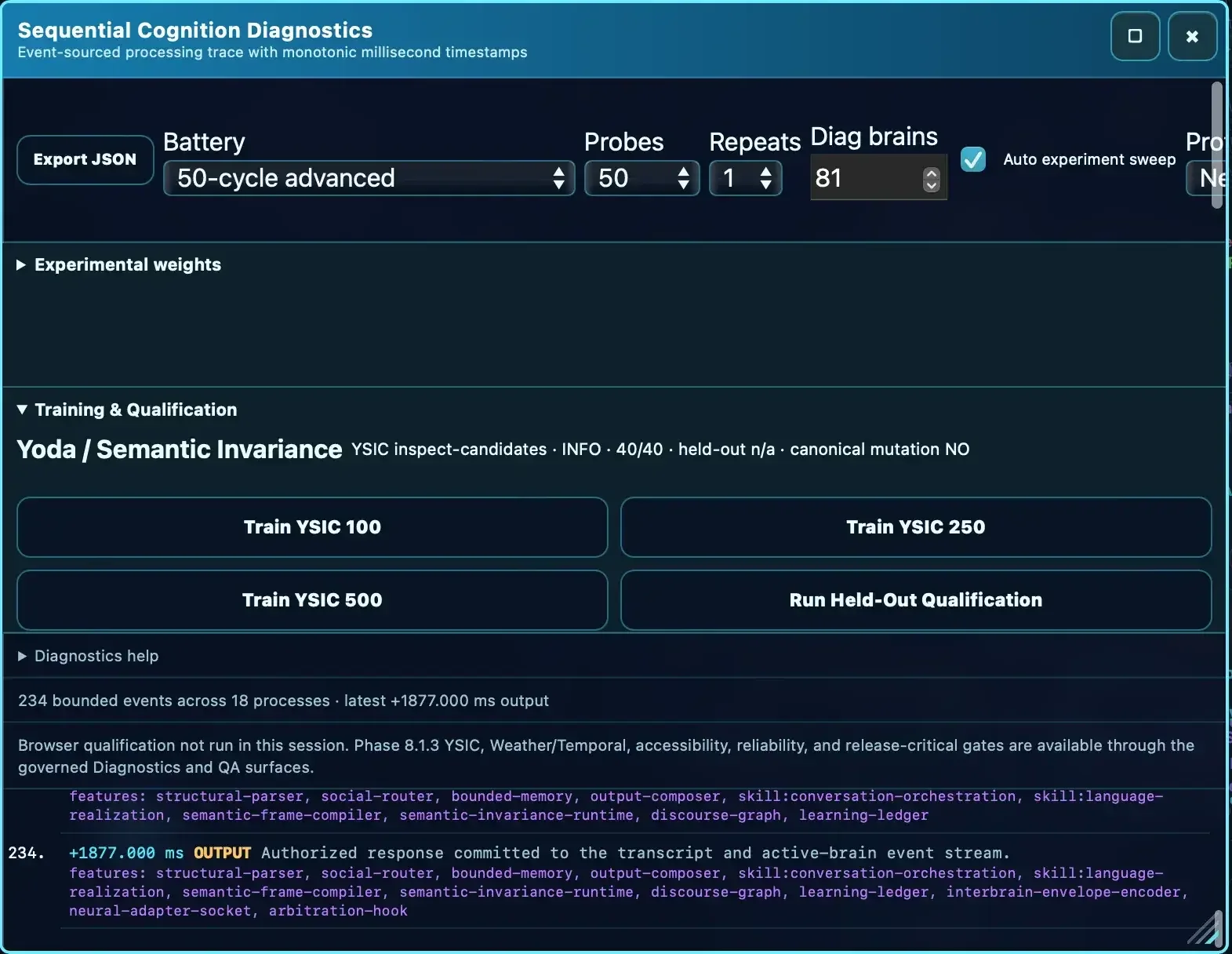
XERXES Sequential Cognition Diagnostics showing a 50-cycle advanced battery, 81 diagnostic brains, qualification controls, bounded events, and an event-sourced processing trace with millisecond timing.DEVELOPMENT EVIDENCE // AUG 2026 // SOURCE UI PRESERVED
XERXES // PUBLIC EVIDENCE // PROPRIETARY

Cognition becomes an event stream that can be inspected and qualified.

The diagnostics surface shows a 50-cycle advanced battery, configurable probes and diagnostic brains, training and held-out qualification controls, bounded process events, and a sequential trace with millisecond timestamps. The visible sequence includes stages such as context, route, reason, evidence, compose, authorize, and output.

Why it matters: this turns debugging and qualification into part of the cognitive platform itself. The ambition is not simply to obtain an answer, but to make the path to the answer observable enough to test, compare, falsify, and improve.

06MODEL INSPECTOR // LIVE CAPTURE
Preview of the XERXES Model Inspector demonstrationDEVELOPMENT EVIDENCE // AUG 2026 // SOURCE UI PRESERVED
OBSERVABILITY MILESTONE

Watch the model inspector traverse the live system.

The video demonstrates the inspector as an operational instrument rather than a static screenshot. It is loaded only after an explicit user action, preserving mobile performance and the protected-media model.

The long-term significance is straightforward: if XERXES continues to scale while preserving this degree of observability, researchers may be able to inspect cognitive participation at a granularity that is fundamentally different from treating intelligence as one opaque output surface.

THE DIFFERENTIATOR

Most AI demonstrations optimize for the answer. XERXES is simultaneously building the answer, the skill surface, the diagnostic trace, and the inspectable cognitive model. That does not by itself prove general intelligence or superiority to frontier models. It does create a potentially valuable research and engineering advantage: a system designed from the beginning to make cognition observable, testable, and governable.

Capability Milestones // Cycle 5

The system is no longer only demonstrating cognition. It is beginning to gain useful skills.

Something important has changed. XERXES is beginning to cross the line from a developmental reasoning experiment into a system that can acquire, apply, and hand back practical capability.

The milestones below are intentionally described only at the outcome level. The implementation methods, internal formulas, thresholds, routing logic, learning structures, and proprietary mechanisms that make them possible are not disclosed in this public edition.

NEW CAPABILITY BORN

The weather skill

A practical weather capability was created and brought into the working system. The significance is larger than weather itself: XERXES demonstrated that a new useful skill can be added to the developing intelligence and presented as part of the same coherent system.

Time awareness

XERXES can now answer basic time requests and use time as part of ordinary interaction. A small capability on paper; an important step toward an intelligence that is increasingly grounded in the operating world around it.

Code generation

The system can intelligently produce useful basic code across multiple technical languages—including BASIC, C++, Bash, HTML and other growing specialist areas—rather than merely discussing programming in the abstract.

Code editing and repair

XERXES is beginning to edit, revise, explain and repair basic code. The direction is toward a system that can participate in an engineering workflow: understand the request, construct an artifact, inspect it, and improve it.

Code becomes a usable artifact

Generated work is no longer trapped inside a conversation. Code produced in XERXES windows can be copied or transferred out as usable file content—for example C++, HTML or Bash—moving the system from answer generation toward practical artifact creation.

Learning is still underway

This remains an early learning system. Its knowledge is intentionally incomplete and its skills are still being expanded and tested. That is precisely why the trajectory matters: these capabilities are appearing before broad learning is finished.

Individually, weather, time, code, editing and file output may sound ordinary because mature AI systems already perform them. Inside XERXES, their importance is developmental: they are evidence that the architecture is beginning to accumulate practical competence without abandoning its deterministic, inspectable cognitive foundation.

The milestone is not that a computer can print C++ or report the weather. The milestone is that this young non-LLM cognitive system is beginning to learn how to do more things.

PUBLIC DISCLOSURE BOUNDARY // Capability outcomes are shown. Proprietary implementation details are intentionally withheld.

Skill Birth // Weather + Temporal Intelligence

Capabilities are becoming first-class visual tools, not just sentences in a chat.

PRODUCTION SKILL MILESTONE

Weather Intelligence

The Weather capability has crossed from experiment toward a dedicated, production-oriented skill surface designed around real structured data, location and time context, forecast information, and clear graphical presentation.

Its significance is architectural: a specialized capability can be born, integrated, presented coherently, and qualified without turning the entire system into one monolithic model. Synthetic fixtures belong in testing; runtime answers are intended to come from live data.

LIVE DATA→SKILL→COGNITION→VISUAL CARD
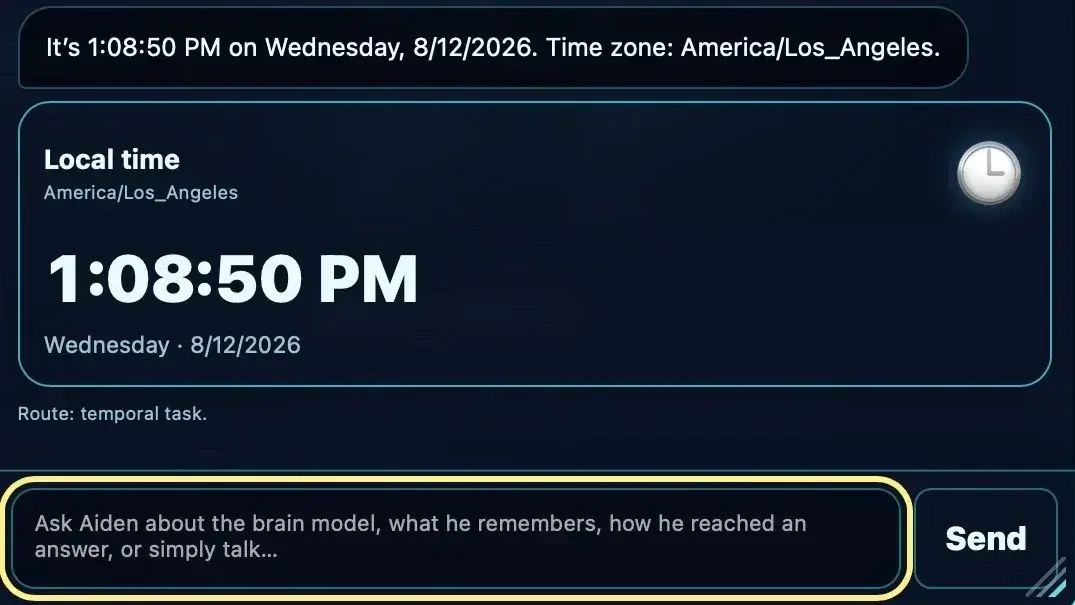
XERXES temporal skill displaying the current local time in America Los Angeles as a dedicated graphical Local time card.HISTORICAL DEVELOPMENT CAPTURE // AUG 2026 // PRE-SIDE INTERFACE NAMING PRESERVED AS CAPTURED
XERXES // TEMPORAL SKILL // PUBLIC EVIDENCE
TIME SKILL // VISUAL CARD

Temporal reasoning now has a user-facing artifact.

The capture shows XERXES answering the time request and then rendering a dedicated Local time card with timezone, clock, date, and route information. The capability is no longer limited to plain conversational text.

Why it matters: this is the beginning of a consistent skill UX. Weather and Time become reusable cognitive tools with their own visual surfaces while remaining available through natural language.

Observed System Evidence // Actual Workspace Captures

From self-awareness to useful work: three screenshots, one developmental trajectory.

These are not concept renders. They are captures from the working XERXES Wizard environment. Together they show a progression that matters more than any isolated benchmark: the system can describe its current operating state, answer across different kinds of ordinary requests, and then turn a natural-language programming request into a usable file inside its virtual workspace.

The significance is the transition from conversation → grounded capability → artifact-producing workflow. The public evidence shows outcomes only; proprietary mechanisms remain intentionally undisclosed.

01SELF-DESCRIPTION
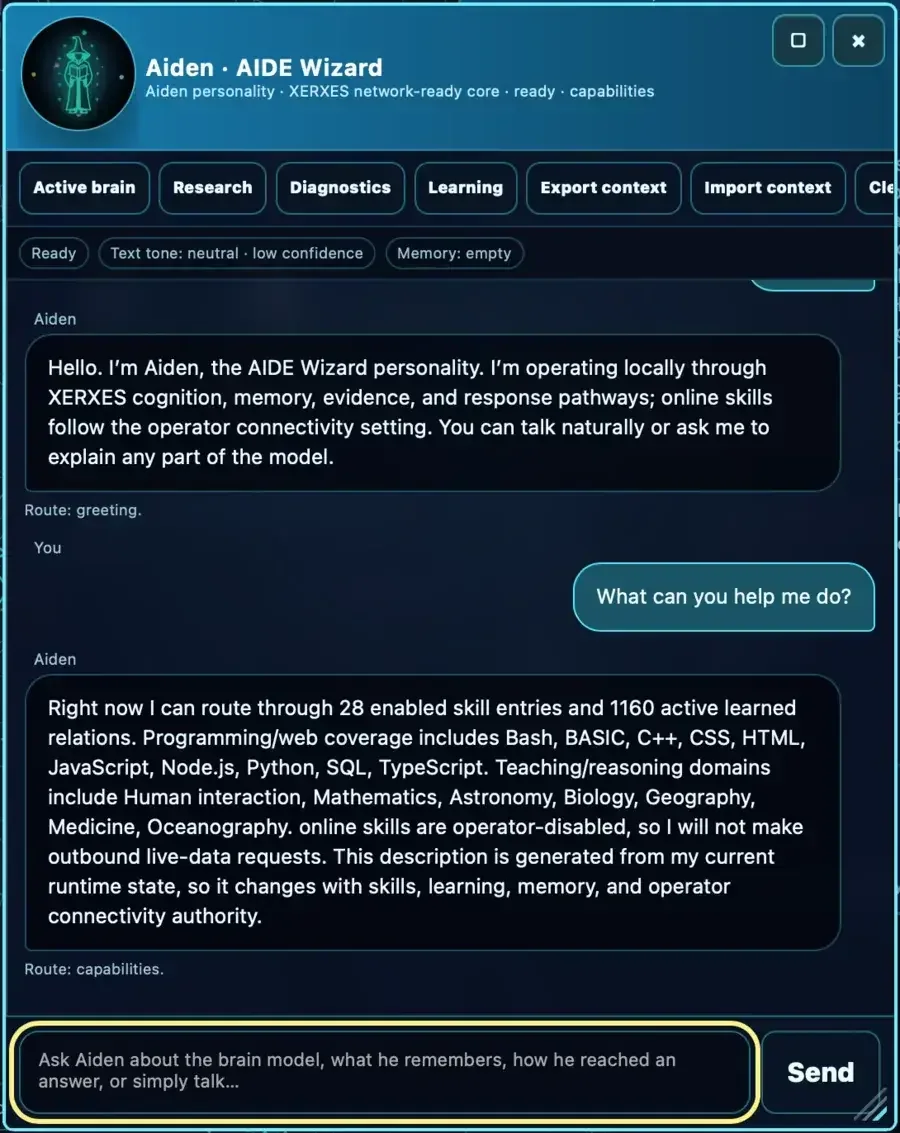
XERXES Wizard workspace showing a system introduction and a runtime-generated description of enabled skills, learned relations, and operator-controlled connectivity state.HISTORICAL DEVELOPMENT CAPTURE // AUG 2026 // PRE-SIDE INTERFACE NAMING PRESERVED AS CAPTURED

The system describes the system it is currently running.

The Wizard interface introduces itself through the XERXES environment and then answers “What can you help me do?” with a description tied to its current runtime state. The capture explicitly says that the description changes with skills, learning, memory, and operator connectivity authority.

Why investors should care: this is evidence of an increasingly inspectable capability surface—not merely a fixed marketing persona. The system exposes what it can currently do and acknowledges operational constraints.

02CONTEXT SWITCHING
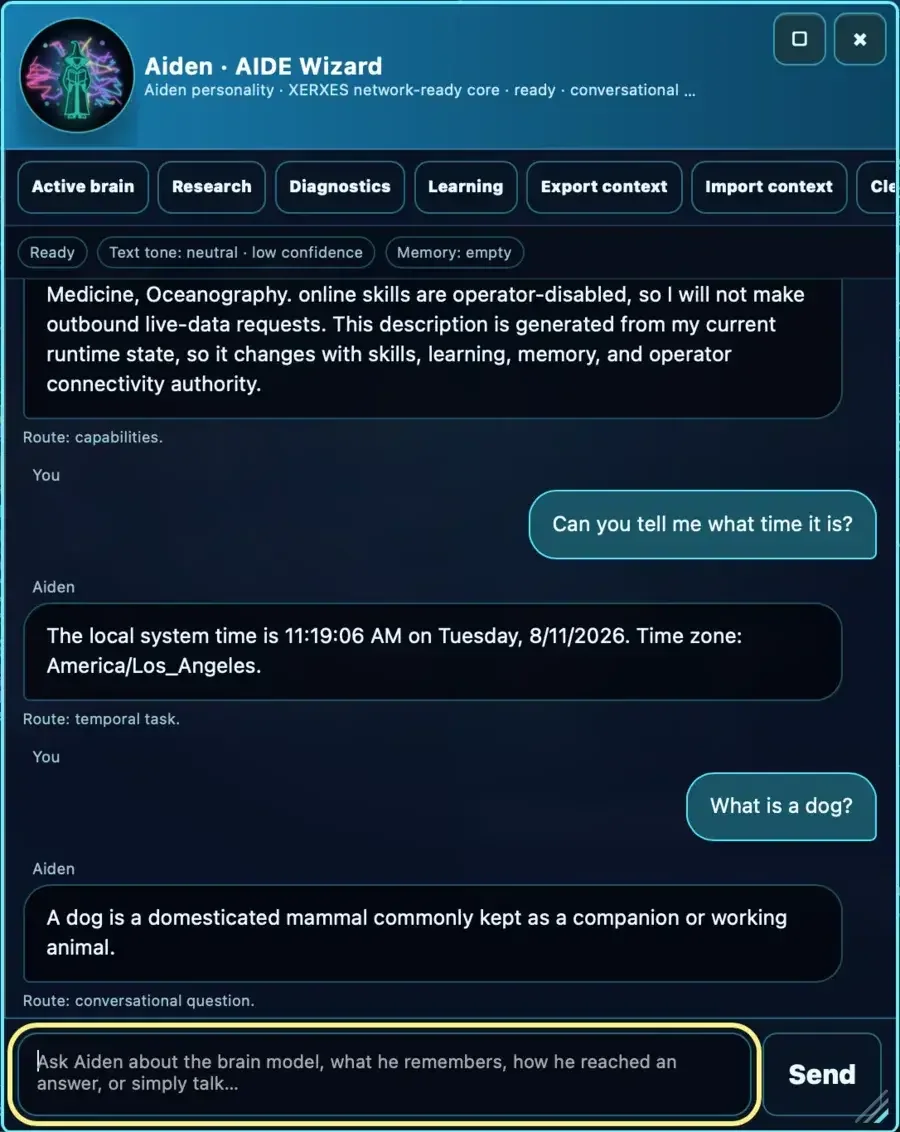
XERXES Wizard workspace answering the local time and then answering a general-knowledge question about a dog within the same conversational interface.HISTORICAL DEVELOPMENT CAPTURE // AUG 2026 // PRE-SIDE INTERFACE NAMING PRESERVED AS CAPTURED

One interface, different cognitive jobs.

The same session moves from a temporal request—reporting local system time and timezone—to ordinary semantic knowledge about a dog. The interface also shows explicit route labels, making the shift in task type visible instead of hiding it behind a single opaque response surface.

Why investors should care: the interesting milestone is not knowing what a dog is. It is a young, limited-learning non-LLM system beginning to move coherently between distinct classes of useful request while maintaining the same conversational workspace.

03VIRTUAL WORKSPACE → USABLE ARTIFACT
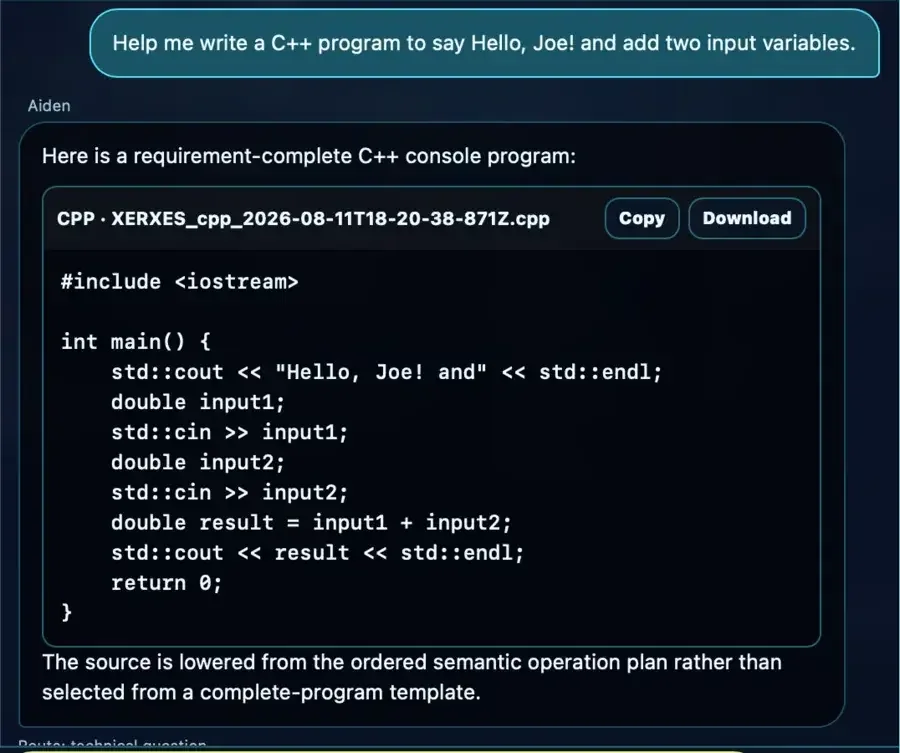
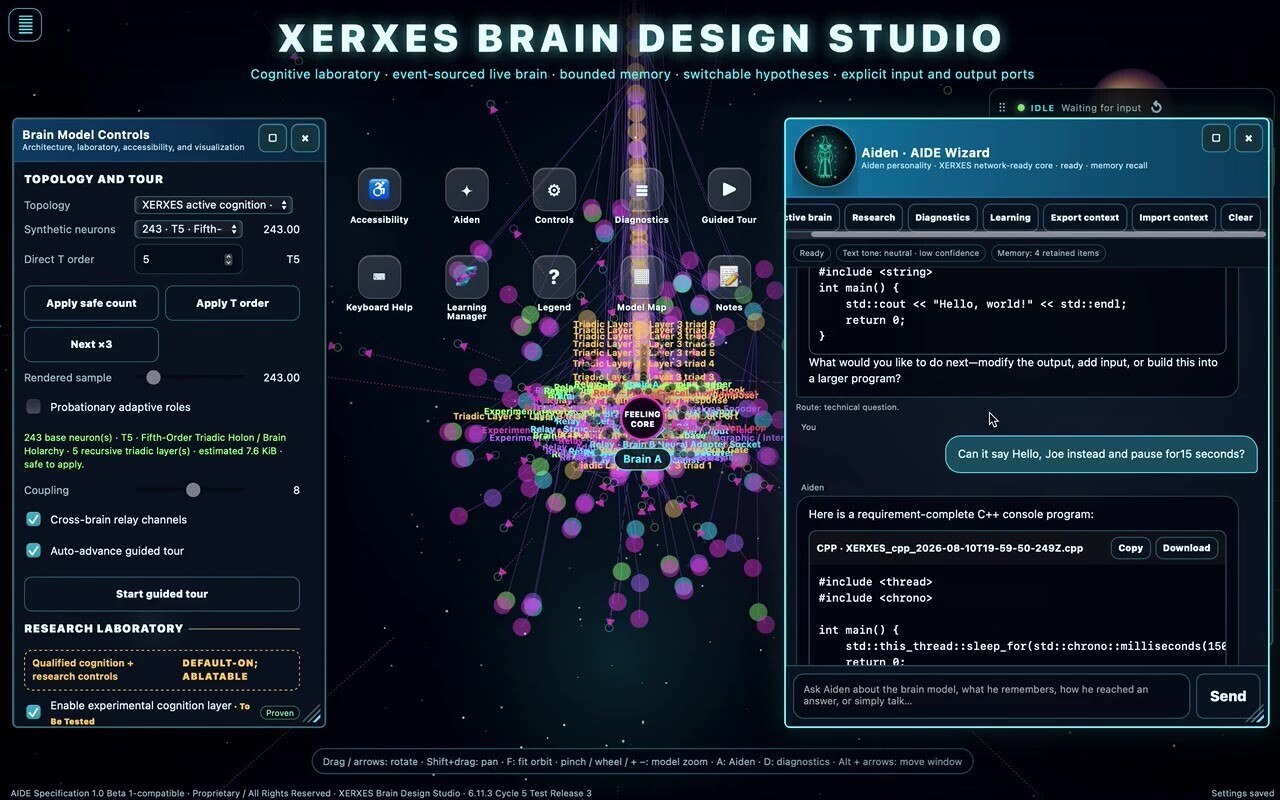
XERXES Wizard virtual workspace showing a generated C++ source file with a filename, complete program, and visible Copy and Download controls.HISTORICAL DEVELOPMENT CAPTURE // AUG 2026 // PRE-SIDE INTERFACE NAMING PRESERVED AS CAPTURED
WORKFLOW MILESTONE

The answer becomes a file.

A natural-language request asks for a C++ program that says “Hello, Joe!” and adds two input variables. XERXES responds with a requirement-complete C++ source artifact inside an actual virtual workspace—not merely loose text in a chat bubble.

REQUEST→GENERATE→FILE→INSPECT→COPY / DOWNLOAD

The capture visibly includes a generated `.cpp` filename plus Copy and Download controls. That means generated engineering work can leave the conversational surface as usable source content and enter the user’s real workflow.

Why this is significant: this is the bridge from “AI that talks about work” toward a cognitive system that produces work products. The same artifact model can support other growing coding capabilities such as BASIC, Bash and HTML while preserving the public/private implementation boundary.

THE INVESTOR SIGNAL

Self-description. Task switching. Artifact creation. These are modest capabilities when viewed individually against mature frontier systems. Their importance here is when they are appearing: during an early, limited-learning phase of a compact non-LLM cognitive architecture. The question is no longer whether XERXES can produce isolated demonstrations. The question is how quickly this capability curve expands as learning, qualification, and real-world skills continue to accumulate.

XERXES // PUBLIC DEMONSTRATION // PROPRIETARY // © 2026 // SESSION
Protected public demonstration — copying and extraction are disabled where the browser permits.