
XERXES SI
Owns and commercializes the Synthetic Intelligence platform.
The opportunity is the combination of cognitive capability, repeatability, inspectability, extreme early efficiency signals, and a direct path from laboratory intelligence to governed commercial action.
PUBLIC COMPANY + TECHNOLOGY BRIEF // No securities terms or offering conditions are published on this page.
The company, core architecture, development environment, deployment layer, and human interface are deliberately separated. That creates multiple surfaces for productization while keeping the intelligence core coherent.
Owns and commercializes the Synthetic Intelligence platform.
The synthetic-neuron intelligence architecture.
Design, visualize, diagnose, qualify, and evolve cognition.
Package and launch useful Synthetic Intelligence capabilities.
Conversation, personality, control, explanation, and human interaction.
Two real development captures anchor the investor brief. They support narrow claims about inspectability and qualification surfaces; they do not substitute for production-scale reliability, market adoption, or end-to-end benchmark evidence.
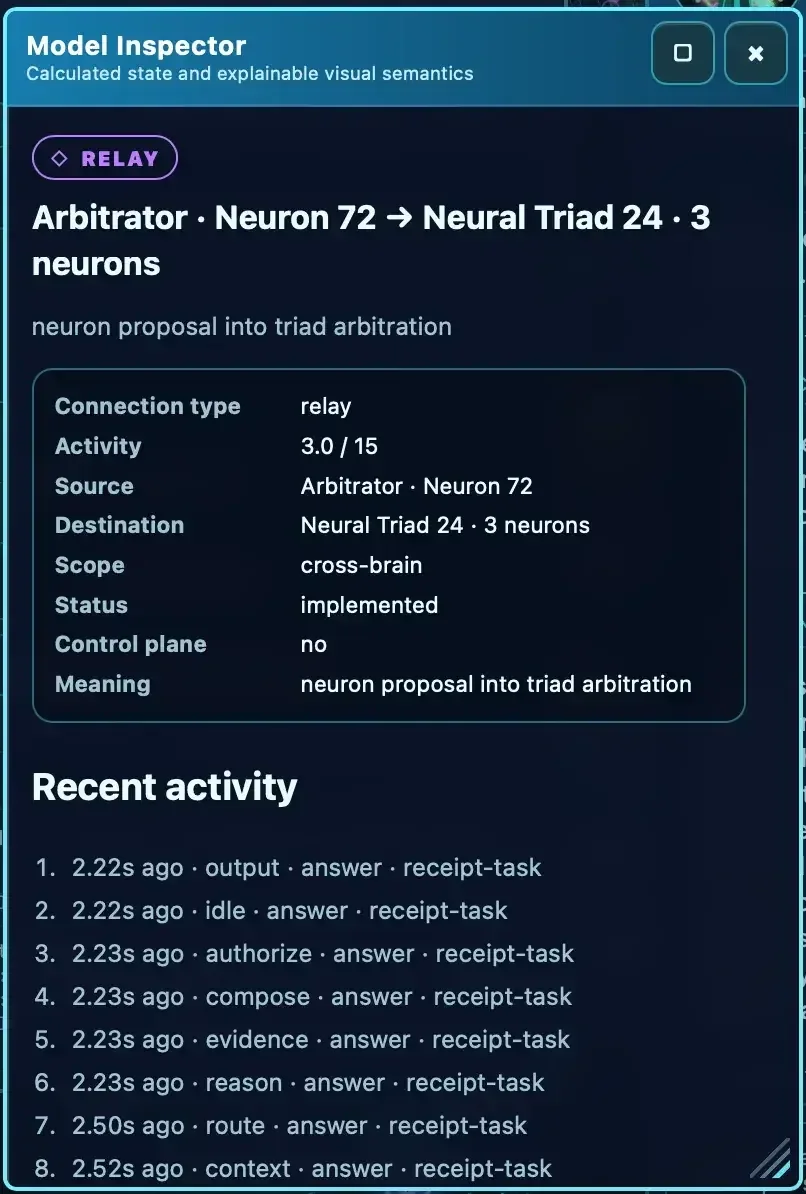 DEVELOPMENT EVIDENCE // AUG 2026 // SOURCE UI PRESERVED
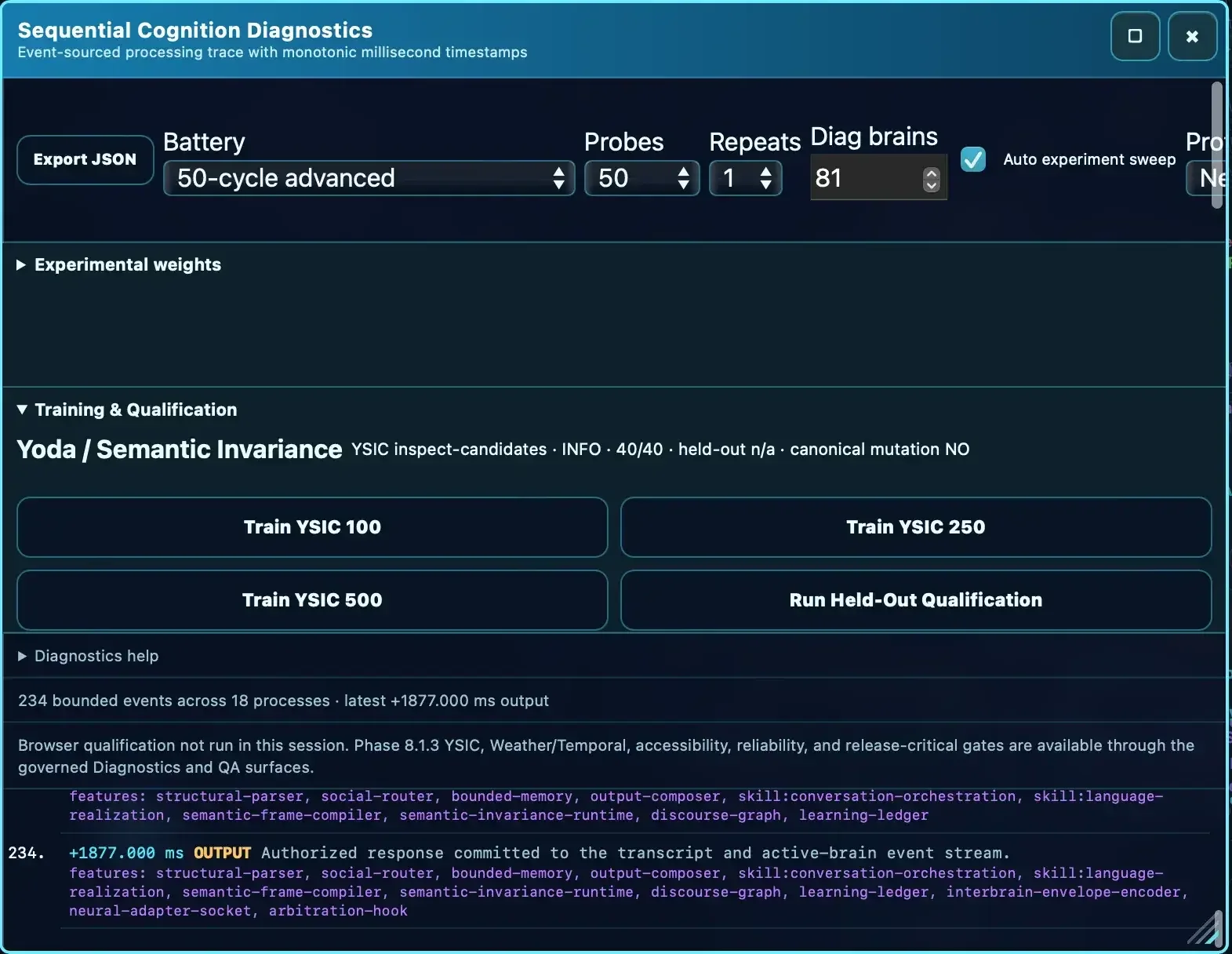 DEVELOPMENT EVIDENCE // AUG 2026 // SOURCE UI PRESERVED
XERXES is already functioning as more than a research diagram: it can hold structured conversations, execute repeatable tasks, retrieve live Weather data and render Weather cards, work with Time, create code and named file artifacts, and expose internal cognitive activity. The investment case is that basic LLM-class application utility is appearing extraordinarily early inside an architecture designed from the beginning for inspectability, selective computation, memory, skills, qualification, and governed action.
Sequoia argues that 2026 is the year many AI products try to move from assisting work to actually performing it—exactly the transition XERXES is preparing for with governed external skills.
Sequoia Capital · Services: The New Softwarea16z describes AI as an enterprise orchestration layer and says agent-native infrastructure must solve routing, state, coordination and policy enforcement at scale.
Andreessen Horowitz · Big Ideas 2026a16z frames AI software development as a potentially trillion-dollar stack. XERXES already crosses from natural language into named code artifacts and a working file surface.
Andreessen Horowitz · AI Software Development StackOpenAI’s enterprise agent platform emphasizes identity, permissions and boundaries—evidence that enterprise buyers increasingly need controllable action, not intelligence alone.
OpenAI · Frontiera16z describes governed AI experiences sitting above systems of record, reading enterprise state and executing workflows through APIs, approvals and audit controls.
Andreessen Horowitz · Systems of ActionBessemer’s 2026 portfolio includes an enterprise control plane for AI agents, reinforcing that orchestration, security and governability are becoming standalone infrastructure categories.
Bessemer Venture Partners · AI Agent Control PlaneIndependent review, code quality and explainability around AI-generated software attracted a $1.5B valuation.
ReutersNatural-language software creation has become a major venture category, validating software-generation workflows as a high-value market.
The Wall Street JournalThe differentiated bet is the inspectable organization, qualification, memory and governance layer that can sit around coding, tools, APIs and models.
External financings are market context only—not valuation comparables or evidence of XERXES product-market fit.
A model-independent organization layer whose value can survive changes in the underlying predictive model.
Model Inspector, sequential diagnostics, provenance and qualification create a path toward enterprise-grade observability rather than black-box operation.
Time, Weather, coding, file artifacts and future API-backed skills demonstrate a system designed to accumulate useful capabilities rather than remain a single-purpose demo.
Useful cognition has appeared in a compact footprint on legacy hardware while internal experiments already show dramatic reductions in coordination work. If that selectivity survives scaling, the economic leverage reaches compute, power, cooling, and hardware density.
Code generation already crosses into a virtual file workspace with Copy and Download actions—the beginning of software that produces work products, not just prose.
Email + Calendar APIs and the client/server transition create the bridge from local cognition to persistent, governed, networked action.
In controlled XERXES experiments, selective coordination has already produced greater than 90% mean message reduction versus naïve broadcast, an average of 7.35 active roles versus an always-deep 81-role control, and approximately 94.4% fewer estimated semantic coordination messages in that workload. Those are architectural measurements—not marketing estimates.
Measured mean reduction versus naïve broadcast in tested cognitive-token experiments.
Fewer active roles in the adaptive recursive-depth experiment versus the always-deep control.
Estimated reduction in semantic coordination messages in that controlled workload.
Demonstrated on decade-old consumer hardware, with the captured workload not relying on the installed discrete GPU.
At data-center scale, compute does not stop at the processor. It propagates into electricity, thermal load, cooling, rack density, capital equipment, and operating expense. The IEA projects global data-center electricity consumption to roughly double to about 945 TWh by 2030. If XERXES can preserve useful capability while activating dramatically less cognition, the same hardware budget could support materially more useful work.
What becomes defensible is the accumulated architecture, qualification history, skill ecosystem, operator trust, diagnostic evidence, deployment knowledge, and proprietary learning structure that make each new capability safer and faster to integrate than the last.
Public outcomes are visible; implementation recipes, weights, thresholds and internal learning mechanics remain private.
Every capability can accumulate regression evidence, failure cases, provenance and promotion/rejection history.
Weather, Time, code artifacts, Email and Calendar become reusable organs inside one governed environment.
Inspector, event traces, permissions, auditability and deployment controls can become part of the product—not an afterthought.
Inspector, event traces, code files, qualification surfaces, Time skill card and protected public demonstrations.
Email and Calendar with authenticated APIs, explicit permissions, audit trails, failure handling and operator control.
Persistent state, isolated users, remote skills, server-held secrets, synchronization, resumability and private deployment.
One narrow workflow where XERXES measurably improves reliability, observability, cost, or control against a defined baseline.
The strongest pitch is not “believe we already won.” It is “look at how much has become falsifiable.”
XERXES is not a mature frontier coding agent or general-purpose foundation model—and it does not need to be one for the current result to matter. A system in early development is already demonstrating basic LLM-class application behavior: structured conversation, live information skills, repeatable task execution, code and file artifacts, specialized interfaces, and inspectable cognition. Investors are being asked to evaluate the trajectory: what is already useful, how little learning and infrastructure it required to get here, and whether that advantage compounds as Email, Calendar, client/server operation, and harder qualification workloads come online.
The upside is asymmetric because the thesis is larger than one model: if cognition becomes an organization problem, XERXES is building the laboratory—and potentially the operating layer—for that problem.
XERXES should not be dismissed as merely a smaller language model. It is reaching some of the same application territory through a different cognitive architecture.
Today it already demonstrates basic language-model-class utility—conversation, live information retrieval through skills, code and artifact creation, task continuity, and specialized interfaces—while remaining far younger and narrower than mature frontier systems. That asymmetry is the experiment.
In tested workflows, explicit cognitive structure can also provide an advantage that probabilistic generation does not guarantee: repeatable instruction adherence, inspectable process, and deliberate control over which capabilities participate. Mature LLMs remain vastly stronger in broad learned knowledge, advanced coding-agent behavior, multimodal generation, and many open-ended tasks; XERXES is testing whether cognition can make selected workflows more reliable and dramatically more efficient.
The architecture can also be hybrid when useful: predictive models can supply broad language or generative capability while XERXES supplies organization, verification, memory lineage, error correction, routing, deliberation, learning control, and action authorization. But the increasingly interesting result is that XERXES is already performing useful work independently at a developmental stage where conventional AI projects would normally still be assembling foundations.
The commercial opportunity is larger than one model release. As AI systems become collections of models, agents, memories, tools, verifiers, and specialists, the organization layer becomes strategically important. XERXES is being built directly for that layer.
Potential markets include AI architecture research, agent-system development, explainable cognition laboratories, advanced simulation, robotics cognition, autonomous systems, AI safety research, decision intelligence, scientific discovery systems, education, enterprise orchestration, model-evaluation laboratories, university research, and neuromorphic and post-transformer experimentation.
The studio concept creates a platform business rather than a single-model business: professional brain-design licensing, enterprise private deployment, research editions, simulation and qualification tooling, cognitive architecture SDKs, certified learning packs, model accelerator adapters, diagnostic and observability tooling, visualization modules, specialized cognitive packs, and eventual marketplace dynamics.
No specific revenue claim is made. The investment thesis is architectural leverage. If XERXES becomes a preferred environment for designing cognitive systems, the value is not tied to one particular neural model winning forever.
The engineering thesis can be stated cleanly:
And intelligence may not be one algorithm.
XERXES is an attempt to build the infrastructure in which those distinctions can exist simultaneously and interact productively.
The next major engineering move is a client/server XERXES architecture. The local cognitive environment has reached the point where selected skills can begin to depend on governed external services without making external APIs the mind itself.
The immediate next skills are Email and Calendar. They introduce authenticated API-backed action and real-world state: reading or composing messages, understanding schedules, checking availability, and eventually coordinating work. The strategic distinction is that APIs provide controlled capabilities and data; XERXES remains the cognitive and governance layer deciding how those capabilities participate.
The investment implication is not “another assistant gets email.” It is that the cognitive architecture is beginning to acquire an I/O layer to the real world. If the local reasoning, memory, explainability, skill model, and diagnostics can be preserved while capabilities move behind secure network boundaries, XERXES can evolve from a laboratory application into infrastructure.
Roadmap statement, not a completed-capability claim. Email, Calendar, and the client/server transition are the next development targets and remain subject to security, reliability, privacy, and qualification gates.
Artificial intelligence has spent the last decade proving what enormous predictive models can do.
XERXES asks a different question:
What happens when we begin designing the organization of cognition itself?
What happens when adaptive neurons can recruit one another?
When groups form groups?
When an opposing thought is mandatory?
When imagination is encouraged but not trusted automatically?
When feelings participate in the neural fabric?
When error signals can awaken deeper cognition?
When communication is routed rather than broadcast?
When delayed consequences can revise judgment months later?
When the architecture can explain not only what it answered, but which parts of the brain participated and why?
These are no longer purely theoretical questions inside XERXES.
Several mechanisms already work.
Several have already produced measurable efficiency gains.
Several have transformed failing cognition tests into reproducible passes.
Others are showing sufficiently strong early signals to justify controlled experimentation.
The most responsible way to describe the system today is neither modest to the point of invisibility nor promotional to the point of fiction.
XERXES BRAIN DESIGN STUDIO is an experimental cognitive engineering platform with a functioning developmental synthetic-neuron architecture and a growing body of proof-of-concept evidence.
It is designed to let researchers and engineers build the next experiment instead of waiting for the next monolithic model release.
And it is testing a proposition with potentially large consequences:
The next major advance in artificial intelligence may not come only from making the predictive model larger.
It may come from giving intelligence a better brain.
XERXES and Dash X were both built in SIDE. That matters to the underwriting case: the company is not relying on one isolated model or interface. It is developing a creation platform capable of producing different systems while XERXES SI concentrates its principal technical story on the XERXES Synthetic Intelligence core and Brain Design Studio.
The Synthetic Intelligence core and the central technical breakthrough.
EXPLORE XERXES →A separate operational product already live under the XERXES SI product family.
VISIT DASH X →